
When you say Scotch...
...what do you mean? What others mean and how is it different
CULTURE
9/9/20258 min read
Go dtuga Dia deoch duit as an tobar nach dtránn (May God give you a drink from the well that never runs dry) - Scottish proverb
For many people whisky means "Scotch". For others - "Bourbon". Some of us even understand the difference between "whisky" and "whiskey".
Let's peek into the world of a widely acknowledged whisky making country - Scotland - the country of cultured moonshiners. Driving through flatlands and hills of Scotland is fascinating to the eye with the extensive green landscape dotted with tiny groups of small houses and medieval castles (often in ruins). You encounter distilleries here and there. It is amusing to wonder why they built the distillery in this particular place. However, in most cases, the booze crafting factory integrates well with its surroundings.
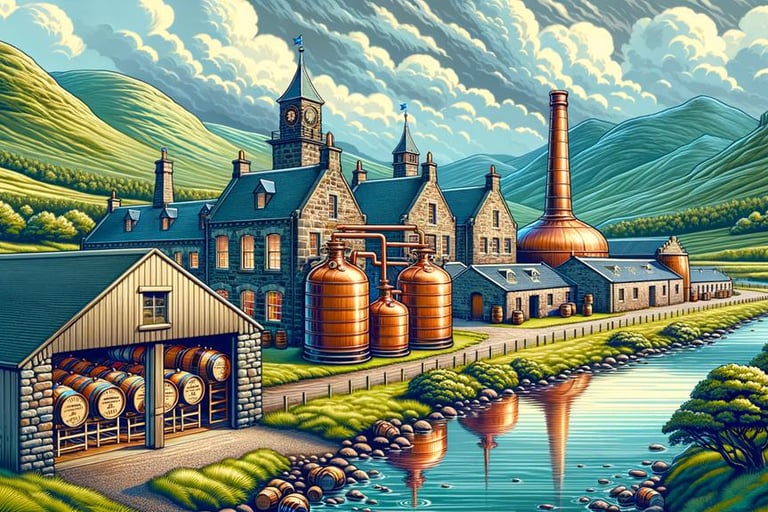
One of the "conspiracy" theories says that the summer - the agricultural cultivation season - in Scotland is short. So Scots had nothing to do most of the year. And it is not a Caribbean island, where one can enjoy Pina-Colada, basking in the caressing sun and listening to the rustle of the surf. Sitting at home and listening to screaming kids and grumbling wives requires men with strong souls and steel nerves. And most of us are not. So distilling is a getaway to find silence, get busy, and get some heat.
If or when you're in Scotland, don't miss a visit to one or two distilleries even if you're a convinced teetotaller. Not for drinking, but for the cultural experience. And for the same experience I'd recommend you taste the cullen skink, typical Scottish soup, a bit similar to clam chowder, just more flavorful and a bit smoky.
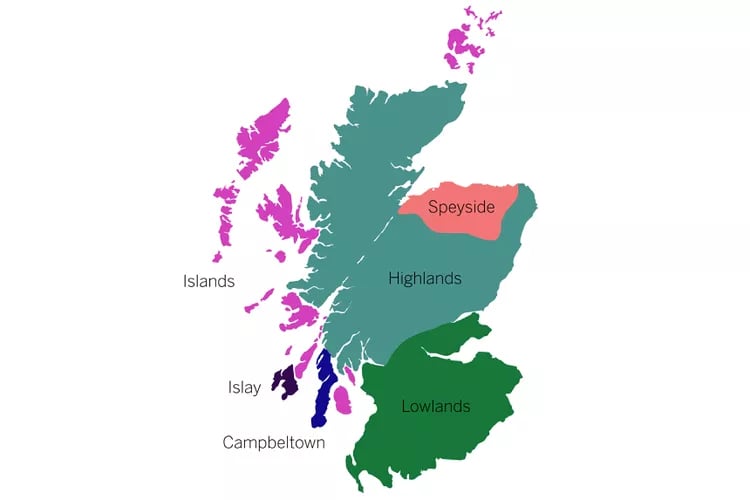
Here is the map of Scotland with typical regions.
An American and Scottish farmer enter the bar. Each one offers a drink to the other. After several rounds the American said: "I have such a huge plot of land that it takes me a full day from dawn to dusk to drive from one side to the other." The Scottish answered: "Well, I also had such a bad car."
Scotland looks small… but it takes very long to get from place to place even in a good car. It's all about narrow and curvy roads and the irresistible will to stop and gaze. As the Scots say, "Many a mickle makes a muckle" — many small things add up to something big. In Scotland, it's not the distance that matters, it's the journey.
Speyside
Speyside is nominally a subregion of the Highlands in the basin or Spey river. But Speyside whiskies have a fairly distinctive character in common among almost all local distilleries.
Speyside is renowned for having the largest concentration of single malt distilleries in Scotland, making it a central hub of whisky production. Speyside's gentle climate, fertile soil, and pure water are key to producing the smooth, elegant whisky profiles for which the area is famous.
Speyside significantly promoted the entire world-known recognition of "Scotch" because Speyside whiskies are best known for their smooth, complex flavors, featuring notes of fruit, vanilla, and spice.
Speyside distilleries paved the way to the USA and other countries for single and blended malts of other regions.
Despite all of them producing "pleasant" whisky, they often cause "holy wars" among aficionados who don't grasp the principle of "De gustibus non est disputandum" ("In matters of taste, there can be no disputes"):
One says "The Macallan is a whisky fashion maker, a golden standard." The other responds: "The Macallan is too industrial and over-engineered in palate." It is better to find a friend to discuss personal sensory discoveries over a dram rather than argue about subjective opinions.
Several examples of most famous Speyside distilleries (in alphabetic order): Aberlour, The Balvenie, Cardhu, Cragganmore, Dalwhinnie, Glen Moray, Glen Spey, Glenfarclas, Glenfiddich, Glenlivet, Glenrothes, Longmorn, The Macallan, Mortlach, Speyside, Tamdhu, Tamnavulin, Tomintoul.
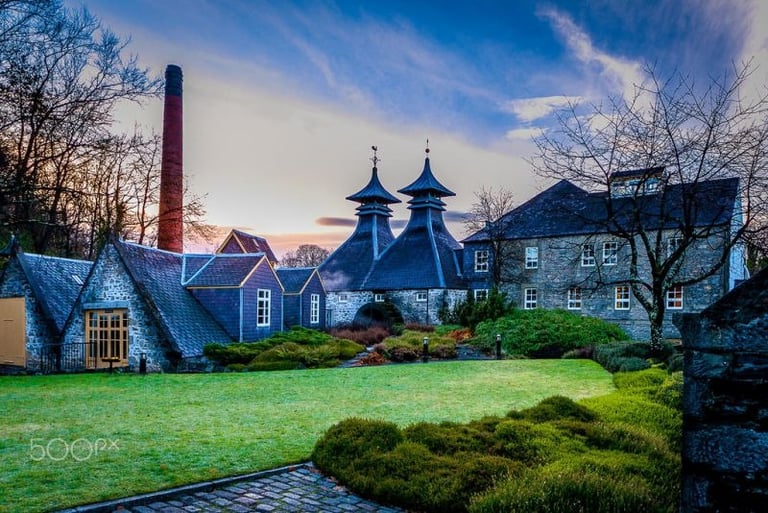
Highlands
Highland whiskies, on the other hand, are generally more robust and sometimes feature notes of smoke and peat. They do, however, exhibit a wide range of characteristics depending on their exact location.
I like to think of Highland whisky as a gamble that always pays off. Sounds fantastic, doesn't it? Either I gain a great whisky for my collection, or I learn something new from every distillery in the region if the organoleptics are not that great.
Highland whiskies swirl you into a lottery of nose and palate. Buying a dram in a bar or bottle in a store you never know what to expect. It's always a thrilling enigma… until the first pour. Hence, tasting Highland whisky in a bar makes more sense than investing in a bottle.
The Highlands have the highest concentration of distilleries per square kilometer in Scotland. One useful thing is good to know about the Highlands: the climate there is harsher and colder than in the Speyside. The whisky aging speed and quality depends on the temperature. Therefore, Speyside whiskies obtain similar aging qualities faster than Highlanders. If you know someone who can distinguish the whisky age by the small and the taste, he will enjoy 15 year old whisky from Speyside more than a similar aged spirit from Highlands. Or, on the contrary, 15 y.o. Highlander has very similar characteristics to 12 y.o. Speyside.
Several examples of most famous Highlands distilleries (in alphabetic order): Aberfeldy, Ardmore, Dalmore, Dalwhinnie, Glendronach, Glenlochy, Glenmorangie, Glenturret, Loch Lomond, Lochside, Oban, Old Pulteney, Tomatin, Wolfburn.
Lowlands
Lowlands whiskies, like Speyside, have a common character: they have been known for producing a gentler, more elegant style of whisky with subtle aromas and mellow taste.
Paradoxically, Lowlands whisky tastes almost like Irish whisky. And not only taste makes them similar. The vast majority of Irish and Lowlands whiskies have floral and tropical scents, gentle touch, and light color. However, among Irish and Lowlands whiskies there are rare producers of smoky and peaty sunshine liquors. What's typical for these Irish and Lowlands whisky "exceptions" is that despite the smoke or peat you can still enjoy the banana, vanilla, lychee, lily of the valley, roses and other stunning fragrances.
If you never tasted “a good Scotch” it’s recommended to start with any Lowlands whisky. If you’re an old stager in the whisky world, it's a good idea to have a bottle of Lowlands whisky.
Several examples of most famous Lowlands distilleries (in alphabetic order): Auchentoshan, Clydesdale, Daftmill, The Glasgow Distillery, Glenkinchie, Kingsbarns, Lochlea.
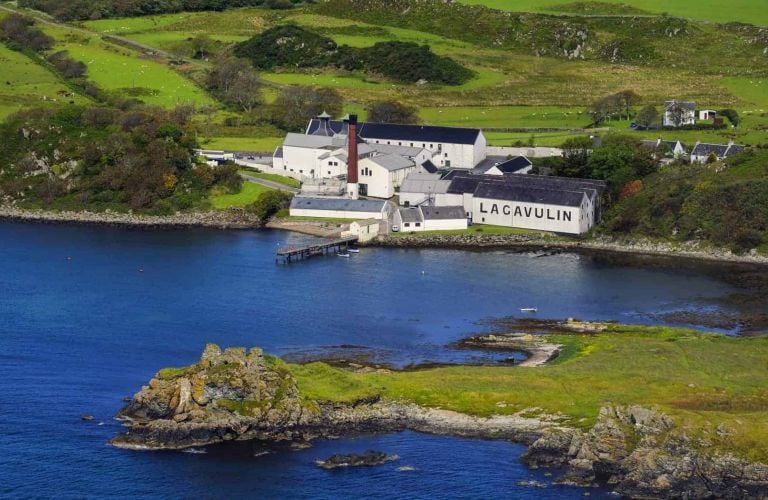
Islay
One snobbish lawyer, after finishing the bureaucracy of purchasing my house, said: "You made a good deal. Let's celebrate it with a good whisky! This bottle costs more than your monthly salary." And he poured a neat dram for me and for himself. Of course, I was curious. In 5 seconds after he opened the bottle I felt that disturbing sense of urgency and emergency, like something is broken or someone needs help. Sniffing the glass I understood why. The whisky smelled like a pharmacy after a marauder's debauch mixed with the exhaust of a metallurgic plant. It was an awful scary nightmare of a smell. "Well," I said to myself, "you already tasted durian in Thailand. Yes, it smelled like sewage, but wasn't it good? Yes," I admitted to myself, "it was as delicious as it was stinky." So I convinced myself to taste the whisky. I was surprised. In fact, I discovered that my nose expectations fully matched the palate. It was like sewage water with a harsh scratch of alcohol.
It appeared to be one of the oldest whiskies of one of Islay's distilleries. No one knows why for the Islay region it's so typical to craft whisky with such distinct odors of peat, smoke, iodine, and industrial heavy machinery aromas. Seems there is enough demand also for this offer.
I like the marketing creativity of Islay's distilleries. Some sell their whisky with different presents like "special glass", a set of stone cubes, or even a certificate of possession of 1 square foot of Islay land.
To be fair, like among Lowland distilleries, in the Islay region there are also proper "exceptions". For example, Bowmore and Bruichladdich produce pretty classic whisky, similar to Speyside style.
Some Islay Distilleries include: Ardbeg, Bowmore, Bruichladdich, Bunnahabhain, Caol Ila, Lagavulin, Laphroaig.
The Islands
At the kindergarten, where I took my kids every morning, there was one teacher who was loved by all the kids. You know, kids are different: some are obedient, others are naughty and rebelling… and then they exchange the roles. I asked myself: "How can such different characters love one, the same, person?" For many days I did not find an answer, until, desperate, I approached the teacher and asked her: "Why do all children in the kindergarten love you? What do you do for them?"
She raised her eyes, gave me a small tender smile and said: "I do nothing special. I treat them all equally, by the individual approach."
Nominally, the Islands of Scotland aren't officially classified as a separate region of whisky culture. There aren't many distilleries scattered across the numerous Scottish islands. The archipelago stretches along the north-west coast of Scotland for hundreds of kilometers. It is huge. However, the only thing that unites all the distilleries of the Islands is "the equal" approach for whisky crafting: the individual approach.
The Islands claim pride of place in Scottish culture when it comes also to legends. Just to remind you of the legend of the Giants.
You can taste all of them and feel the distinctive difference of styles. Some of them you'll like for sure. Others you'll hate for sure. All of them are "The Islands": Abhainn Dearg, Arran, Highland Park, Isle of Harris, Isle of Raasay, Jura, Scapa, Talisker, Tobermory, Torabhaig.
Campbeltown
Nowadays, Campbeltown is the smallest whisky region in Scotland, home to just three distilleries. Fans of its spirits are a passionate bunch. They often seek out bottles far less represented on the market than other regions' bottlings.
In the past, Campbeltown peninsula had about 30 distilleries. So even though it's a small area, the nature of the whiskies produced there made it notable enough for it to have its own designation as a major scotch-producing region. Campbeltown whiskies often have a recognizable character, similar to Islay with comparable exceptions.
However, as most of the distilleries except for three had closed by 2010, whiskies from those closed distilleries command extremely high prices and are very much sought after by aficionados. The only remaining ones being Springbank, Glen Scotia, and Glengyle are prized due to small amounts of production leading to scarcity.
In Conclusion
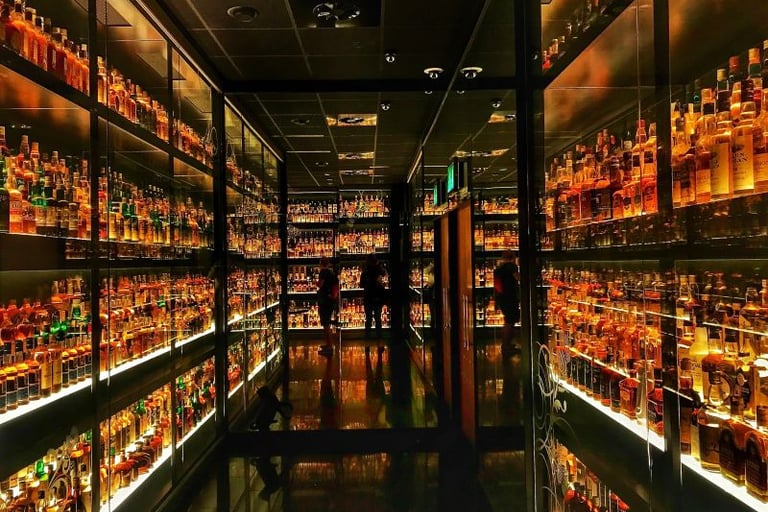
If you drop by Edinburgh, do not miss the Scotch Whisky Experience Museum. Castles, churches, theaters, restaurants and shops you can find everywhere. But if you have only limited time, dive into the whisky experience in the museum. They clearly demonstrate the difference between regions. The tour is not only nice but also enriching your education and sensory experience.
Contact
Questions or thoughts? Reach out anytime.
info@quantumsatis.site
Phone: TBD
© 2026. All rights reserved.