
Traditions of Scottish and Irish Whiskey, part I
Unveiling the peculiarities and nuances between 2 main streams of whiskey crafting
CULTUREHISTORY
8/9/20243 min read


Part I: The Causeway and the Divide
There exists between Scotland and Ireland a peculiar relationship — at once brotherly and contentious, united by the ancient Gaelic tongue yet divided by matters of method and pride. The tale of their separation, as recounted by the folk of both shores, bears particular relevance to our present inquiry into the divergent paths of whiskey craftsmanship.
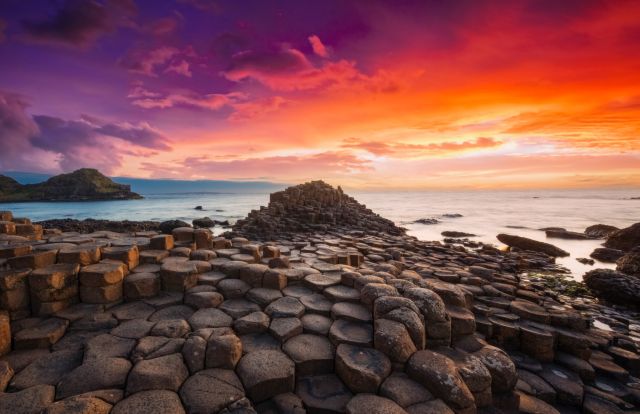
In ages past, so the legend holds, a magnificent natural bridge spanned the waters between Giant's Causeway on the Irish coast and Fingal's Cave upon the Scottish isle. Each nation had its Guardian Giant, sworn to protect the peasantry from devastation and threat. One bright morning, the Scottish Giant, possessed of considerable confidence but insufficient wisdom, concluded that a single protector might suffice for both lands. Ignoring the ancient truth that no man — nor Giant — is an island entire unto himself, he commenced his thunderous march across the bridge toward Ireland.
The Irish peasants, hearing the tremendous footfalls approaching, beseeched their own Giant for deliverance. He calmed them with characteristic cunning: "You all know where I live. When you encounter this enemy, point him to my house. I shall treat with him accordingly."
Hastening home, the Irish Giant instructed his wife thusly: "When the Scottish Giant arrives, inform him that I have gone hunting and bid him wait for my return."
"And what of you?" inquired his wife.
"Meanwhile, I require rest. I shall take to my bed."
"But he shall see you sleeping there!" the woman exclaimed.
"Precisely," replied the Giant. "Tell him — 'Be quiet, please, our baby sleeps in that cradle there. I must not wake him whilst preparing my husband's dinner.'"
The deception proceeded as planned. The Scottish Giant, upon entering the house and spying the enormous figure in the bed, demanded to know the whereabouts of the Irish Giant for purposes of combat.
"He has gone hunting," the wife replied calmly. "Our baby sleeps in the cradle. Please, sir, do not wake him whilst I prepare my husband's supper."
A most remarkable transformation occurred in the Scottish Giant's countenance. If the infant possessed such dimensions, what monstrous proportions and fearsome strength must characterize the father? Without further discourse, the Giant departed, closing the door with uncharacteristic gentleness.
His return journey proved considerably more hurried than his arrival. With each thunderous step, his conviction grew that the adult Irish Giant might prove swifter still in pursuit. The bridge trembled beneath his panicked flight until, at the very moment he gained the Scottish shore, the structure collapsed into the sea through the force of resonance — destroyed not by intention but by fear compounded upon itself.
This tale, dear reader, yields several observations worthy of our consideration:
that the best conflict is one successfully avoided;
that wisdom sometimes achieves what force cannot;
that a small falsehood, deployed with discernment, might produce remarkably positive consequences;
that rumination without factual foundation destroys not merely peace of mind but bridges both literal and metaphorical;
that what is ruined — whether by accident or design — proves infinitely more difficult to restore than to maintain;
and finally, that collaboration brings power whilst separation breeds weakness — as the sundered bridge demonstrates most eloquently.
The Divided Traditions
Just as the bridge no longer connects these neighboring lands, so too have their methods of spirit-making diverged, though both commence with the same noble ingredient — barley.
Yet similarities persist, as familial traits persist despite quarrels: both nations employ barley as the foundation of their craft; both favor used barrels over new; and both achieved their worldwide renown during that peculiar American experiment known as Prohibition — a circumstance we shall examine more closely in due course.
The market, however — or as the plainspoken would have it, money — has proven the ultimate arbiter of tradition's value.
[To be continued in Part II: The Blender's Gambit]
[To be continued in Part III: The American Conquest]
Contact
Questions or thoughts? Reach out anytime.
info@quantumsatis.site
Phone: TBD
© 2026. All rights reserved.