
Traditions of Scottish and Irish Whiskey, part II
Unveiling the peculiarities and nuances between 2 main streams of whiskey crafting
CULTUREHISTORY
7/4/20242 min read
[Previously, Part I: The Causeway and the Divide]
Part II: The Blender's Gambit
Each distillery, whether perched upon Scottish heath or nestled in Irish glen, has fought its private war for the consumer's attention — or more precisely, for the contents of his wallet. A curious tension has long existed between preserving ancestral methods and achieving commercial success. To be an "outlier" from established tradition meant commanding a narrower market share; reduced revenue followed as night follows day; and diminished profit portended weakness against the inevitable force-majeurs that plague any enterprise:
inflation born of catastrophe or war,
legislative caprice,
weather's impact upon harvest,
equipment failure requiring costly repair.
Into this competitive landscape stepped a most unlikely figure — John Walker, proprietor of a modest grocery shop in Kilmarnock, and notably, a teetotaller. Here we encounter one of history's delicious ironies: a man who abstained entirely from spirits built an empire upon their sale, creating a brand recognized today by millions who have never tasted his product.
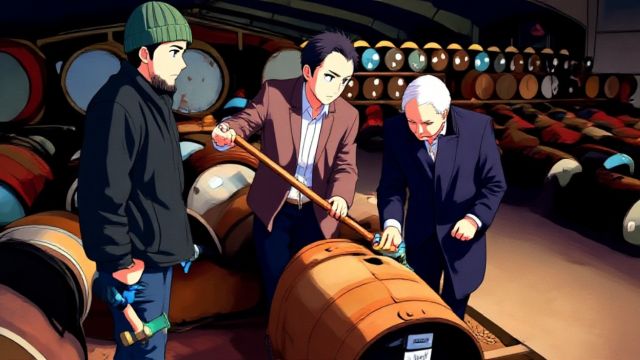
Walker possessed neither distillery nor family tradition of whisky-making. What he did possess was keen commercial insight. From his shop, he began blending various whiskies to suit individual customers' preferences, mixing spirits from different sources to achieve desired characteristics. This custom blending proved so successful that his son Alexander expanded the operation to industrial scale.
The Walker family understood a fundamental principle: the entire process from barley cultivation through malting, fermentation, aging, and bottling presented numerous opportunities for failure, interruption, and catastrophic loss. By the 1820s, the innovative concept of large-scale blending offered an elegant solution to these vulnerabilities.
Numerous small distilleries proved eager to sell their unaged or poorly-aging stocks at prices below reasonable market value. Each such distillery maintained its own "tradition," resulting in spirits of wildly varying quality. By employing skilled Master Blenders and aging these diverse distillates under controlled conditions, Walker could "correct" individual deficiencies and create consistent, recognizable products. The colored labels — Red, Black, Green, Blue, Gold — emerged as markers of this standardized excellence.
Consider the brilliance of this strategy:
Equipment maintenance: Zero, as all fermentation and distillation occurred elsewhere.
Staffing requirements: Minimal—essentially the Master Blenders alone.
Supply chain: Enormously expanded. While individual distilleries proved unpredictable, sourcing from hundreds ensured stability.
Competitive pricing: As principal buyer for many small operations, Walker commanded exceptionally favorable prices, advantages passed to consumers.
The requisite investment lay in warehousing for aging barrels and in cultivating Master Blenders' expertise — a gambit that proved, over time, entirely worthwhile. Today, blended Scotch comprises 90% of Scotland's whisky exports. I neither belittle Walker's commercial acumen nor disparage blended whisky. The man pioneered an entire branch of industry through bold innovation. It remains difficult to overestimate the influence of a single individual upon the world entire.
Yet a question persists: How came blended Scotch to dominate the global market, rather than single malts? And why did Irish tradition become secondary? The answer, dear reader, lies not in Scotland nor Ireland, but across the Atlantic — in a spectacular governmental blunder that would reshape the spirits industry for generations.
[To be continued in Part III: The American Conquest]
Contact
Questions or thoughts? Reach out anytime.
info@quantumsatis.site
Phone: TBD
© 2026. All rights reserved.