
Column Stills and the Quest for Continuous Improvement
The most irrelevant post on the whiskey site. However, contains a chain of amusing paradoxes. Find out all of them.
SCIENCECRAFTHISTORY
8/8/20258 min read
"For every complex problem there is an answer that is clear, simple, and wrong." — H.L. Mencken
In another article, we discussed azeotropy — that unfortunate molecular situation where ethanol and water become so codependent that they refuse to separate completely, like a couple who broke up but still share a Netflix account. This creates what engineers politely call "an explicit challenge" and what the rest of us call "a huge pain in the ass."
The traditional solution to separating volatile substances is distillation, which sounds sophisticated until you realize it's basically just fancy boiling. You heat things up, catch the vapors, cool them back down, and hope you got what you wanted instead of what you didn't.
For centuries, this was done with pot stills — enormous copper pots with elaborate cooling tubes snaking out the top like some kind of medieval plumbing project. They're beautiful in that "functional sculpture" way that makes you want to take photos but not actually operate one yourself.
The Invention Paradox
Pot stills were invented around the 8th century AD by an Arabic alchemist named Jabir ibn Hayyan, which presents us with history's first great distillation paradox: the technology for making alcohol was perfected by someone whose religion explicitly forbids drinking it.
It's like if the most advanced vegan cheese were invented by a cattleman. The irony is so thick you could distill it.
I have a friend who's a talented wedding photographer despite being deeply opposed to the institution of marriage. She says the contradiction makes her better at her job — she can see the beauty in the ritual without buying into the mythology. Maybe Jabir ibn Hayyan felt the same way about alcohol. "Yes, it's forbidden, but look how efficiently this separates volatile compounds!"
This early distillation apparatus spread to medieval Europe and became essential for liquor production, which Europe embraced with the enthusiasm of people who'd just discovered that fermented grain could be made even more fermented.
The Pot Still Problems
The distillation using pot stills is a tedious long process which requires manual control and human supervised attention.
Pot stills work beautifully for what they do, but they have a fundamental flaw that drives efficiency-minded people absolutely insane: they're an interrupted process.
Here's how it works:
Fill the pot with fermented wash.
Heat it for hours while carefully collecting fractions.
When you're done, the pot is full of spent grain mush.
Empty the pot (heavy, messy, smells like despair).
Clean everything (tedious, crucial, easy to skip if you're lazy).
Refill and start over.
This is notorious labor and time investment. It's the equivalent of doing laundry one shirt at a time — technically effective, but you'd better have a lot of free time and a high tolerance for repetitive tasks.
My mother used to make tomato sauce this way, in a single pot, one batch at a time. She'd spend an entire Sunday making sauce, then storing it in jars, then starting over the next Sunday if we needed more. When she discovered she could make multiple batches simultaneously using multiple pots, she acted like I'd revealed the secrets of cold fusion. "Why didn't anyone tell me this before?" she demanded, as if the concept of "more pots equals more sauce" required advanced engineering degrees to comprehend.
For whiskey makers, this interruption isn't catastrophic. Compared to the years their spirit sits in barrels aging, a few hours of cleaning between batches barely registers. It's like complaining about the time it takes to wrap a gift when the recipient won't open it for five years.
But businessmen — who are constitutionally incapable of seeing a process without asking "how can we make this faster and cheaper?" which in fact means “how can we increase the margin with zero investments?” — looked at pot stills and saw inefficiency. They saw labor costs. They saw downtime. They saw opportunity (for revenue, of course).
The Column Still: Or, How to Never Stop Working
The businessmen's desire for quick and easy revenue pushed the engineering mind to develop uninterruptible distillation — a process that could theoretically run endlessly as long as you had fermented wash to feed it and fuel to heat it.
This is called a column still, and it represents humanity's eternal obsession with automation taken to its logical extreme.
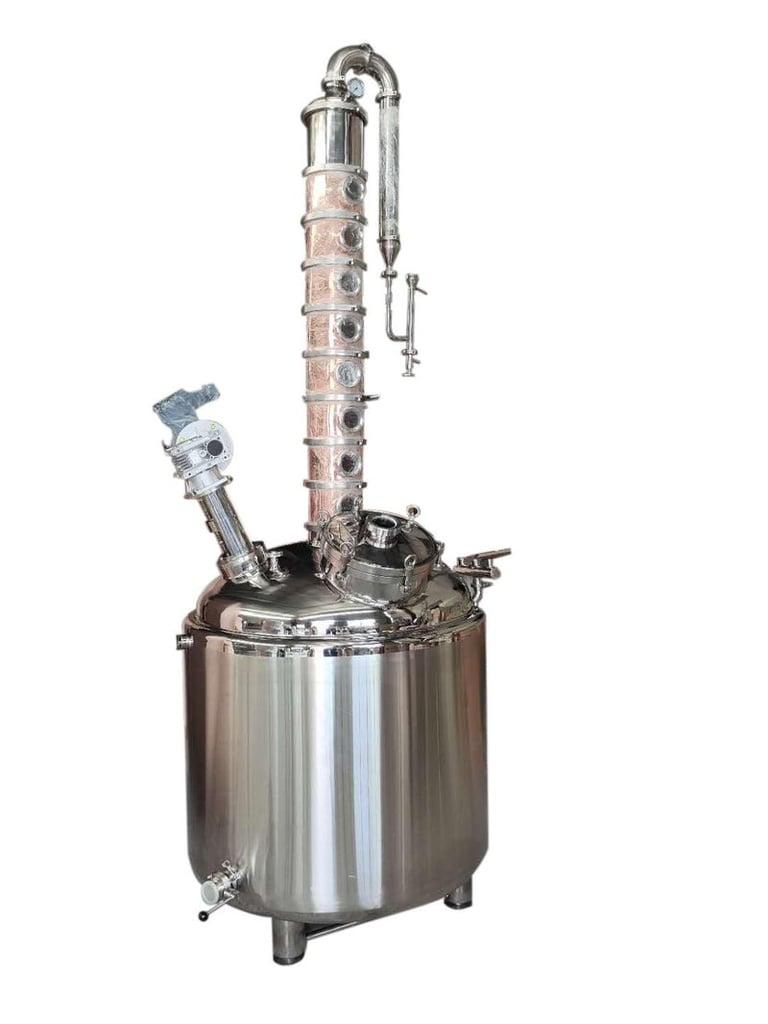
The column still was invented by Robert Stein in 1826 and patented by Aeneas Coffey in 1831. Coffey's patent became the industry standard, which is why column stills are sometimes called "Coffey stills" — a name that makes them sound cozy, like something you'd operate while wearing slippers, when in reality they're industrial towers that run day and night like unmanned factories that never sleep.
Interestingly, many French engineers were involved in the gradual development and improvement of column stills, particularly for Cognac production. The first commercial column still was launched in Belgium in 1826. To this day, in European countries, column stills are called "Belge columns" (Belgian columns), which must annoy the French and English who also contributed significantly but didn't get naming rights.
This is the conference room argument that never ends: "Well, technically, we did most of the work..." "Yes, but WE built the first commercial version..." "But our PATENT..." Everyone contributed, nobody gets full credit, and the Belgians somehow ended up with their name on it.


The Three Paradoxes of Column Stills
Column stills enrich industrial history with three delicious paradoxes that would make Jabir ibn Hayyan proud:
Paradox #1: International Invention Confusion Mainly invented by the French, introduced commercially in Belgium, but patented and popularized by the English (specifically the Irish-born Aeneas Coffey, working in England). It's like if pizza were invented in China, first sold commercially in Sweden, but everyone credits Italy because they filed the paperwork first.
Paradox #2: The Scottish Rejection
The fast spirit producers readily adopted column stills, but the Scottish refuse to use them for Scotch whisky. They stick with pot stills, insisting that tradition and quality matter more than efficiency.
This is the most Scottish thing imaginable: "You've invented something faster and cheaper? How interesting. We'll continue doing it the slow, expensive and traditional way, thank you very much."
Paradox #3: The Non-Edible Triumph The most widespread use of column stills today isn't for drinking alcohol at all. It's for:
Cosmetics industry (separating fragrances and essential oils)
Petroleum industry (separating crude oil into gasoline, kerosene, diesel, fuel oil)
Chemical industry (pretty much everything)
So this technology, perfected for making booze, ended up being far more valuable for making perfume and gasoline. It's like inventing a microwave for defense purposes (actually for attacking, scorching enemy’s soldiers when the chemical weapon is internationally forbidden) and discovering it's actually better at defrosting chicken.
The column still made vodka possible, made gin cheaper, made neutral spirits accessible — and then discovered its true calling was helping ExxonMobil separate hydrocarbons.
Column Stills: The Automation Route
Column stills (also called continuous stills) are what vodka and neutral spirits producers use. They're the industrial answer to pot stills, like comparing an assembly line to a craftsman's workshop.
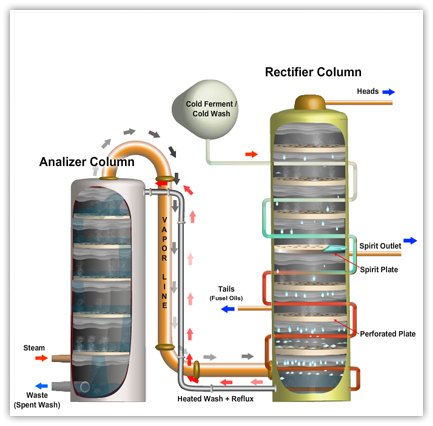
Instead of making cuts manually, column stills fractionate continuously and automatically through something called tray distillation. Imagine a tall column with multiple shelves (trays) stacked vertically:
Hot vapor rises from the bottom.
Cooler liquid trickles down from the top.
Each tray acts like a mini-distillation.
Lighter compounds (Heads) concentrate near the top.
Heavier compounds (Tails) concentrate near the bottom.
Hearts are drawn from the middle trays.
The separation is controlled by:
Reflux ratio (how much liquid you send back down vs. collect).
Draw-off rates (how fast you pull from each section).
Tray temperatures (monitored at multiple heights).
Differential pressure (the pressure difference top-to-bottom).
There's no dramatic "cut moment" where someone makes a decision. It's always happening, continuously, like breathing or aging or slowly losing interest in things you used to care about.
Spirit-Specific Cut Strategies: Personality Types
Here's where distilling becomes intentional — different spirits require different cutting strategies, like how different children require different parenting approaches. One size definitely doesn't fit all.
Whisky: The Precise Perfectionist
Whisky distillers make narrow hearts cuts but intentionally include some tails for mouthfeel. Those heavier compounds add oiliness and texture that people describe as "richness" or "body."
Cut points are also tuned for aging behavior—certain compounds that taste harsh now will mellow beautifully after years in oak. Others will just get worse. Knowing the difference takes experience, chemistry knowledge, and possibly divine intervention.
It's like raising a difficult teenager. Some behaviors are "phases" that'll resolve with time. Others are warning signs you should address immediately. Guessing wrong has consequences.
Rum: The Funky Rebel
Rum producers often make wider cuts and deliberately include late Heads and early Tails for "funk" — those weird, fermented, slightly funky flavors that make rum taste like rum instead of vodka with brown food coloring.
Some rums are clean and elegant. Others taste like a tropical vacation had a baby with a mechanical shop, and people pay good money for that specific combination.
Brandy / Cognac: The Sensory Artist
Brandy and Cognac production is extremely sensory-driven. Distillers minimize Heads aggressively (nobody wants nail polish in their expensive grape brandy), but handle Tails according to house style.
Some Cognac houses partially recycle Tails into the next distillation. Others discard them entirely. Each house guards its specific method like a family secret, and they've been making the same decisions for literally centuries.
This is the equivalent of my grandmother's spaghetti sauce recipe, which died with her because she refused to write it down and got offended when people tried to measure what she was doing. "You add the oregano until it smells right!" she'd snap, as if this were obvious.
Vodka: The Obsessive Minimalist
Vodka producers make extremely tight hearts cuts, remove Heads aggressively, and often run the spirit through multiple distillations or carbon filtration to remove any remaining flavor.
The goal of vodka is to taste like nothing — pure ethanol and water, pure cotton-head, with all character stripped away. It's the Marie Kondo approach to distilling: if it sparks flavor, discard it.
I respect vodka's commitment to neutrality while also finding it slightly depressing, like people who paint every room in their house beige because "it goes with everything."
In Conclusion: The Efficiency Paradox
We started with a simple problem: separating ethanol from water and other compounds. The pot still solved it beautifully but slowly. The column still solved it efficiently but at the cost of character and tradition.
Whisky makers chose character. Vodka makers chose efficiency. Both are right, depending on what you're trying to accomplish.
The Scottish stick with pot stills not because they don't accept efficiency — they get it perfectly. They've simply decided that some things are worth doing slowly, carefully, and traditionally, even when faster methods exist. They prefer tradition over efficiency, hand claps!
And maybe that's fine. Maybe we don't need to automate everything. Maybe some processes benefit from human attention, from interruptions that force you to stop and clean and think before starting again.
Or maybe I'm romanticizing inefficiency because I've never had to actually run a pot still for a living.
But I'll tell you this: when I drink good whiskey, I can taste the difference. I can taste the time, the attention, the decision not to rush.
When I drink vodka, I taste... very little, if nothing, which is exactly the point.
Both have their place. Both serve their purpose.
Contact
Questions or thoughts? Reach out anytime.
info@quantumsatis.site
Phone: TBD
© 2026. All rights reserved.