The roots of Quantum Satis brand
Intriguing story how the brand name was born.
FAQCULTUREHISTORY
11/11/20245 min read
Unlike all other Quantum Satis posts, this one carries no particularly useful educational payload. It's more of a confession than a post. Nevertheless, as Vladimir Mayakovsky, a Russian poet wrote — "If stars are lit in the sky, surely someone must need them!" This post pursues two objectives:
To amuse you, dear reader.
To answer one of the most frequently asked questions.
It's rather immodest to admit that our founder personally gifted us this name, single-handedly. As it turns out, he's loved Latin since childhood — not simply for its sound, but for its ubiquity and usage.
"Hey!" you'll say, "What usage?! It's a dead language!"
And you'd be absolutely right. Nobody speaks Latin these days. Why? Because the power that carried it has perished. The once-mighty Roman Empire disintegrated like grapeshot into tiny counties and states, where every local princeling strived to grab a fatter slice not only from his neighbors but from his own subjects as well. Thus all the Romance languages were born. And Latin died. But not on paper. Precisely because of Latin script, this language was used by scholars of nearly every country as an international medium. Biologists, chemists, philosophers, physicians still use Latin terms in their professional fields. So it turns out that this dead language is spread throughout the world and remains in active use. And how much wisdom it carries! Enjoy with us the power and the beauty of a couple of examples:
Quod me nutrit, me destruit — What nourishes me, destroys me. A sort of call for moderation—you can't live without food, but gluttony is also bad for your health.
Gutta cavat lapidem non vi sed saepe cadendo — A drop hollows out stone not by force but by frequent falling. Or as the English say: "Slow and steady wins the race."
The Pharmacy Encounter


Our founder first encountered the expression Quantum Satis in medical academy during a pharmacology course. When prescribing a mixture, ointment, or powder, a physician can choose an arbitrary composition of medicinal components and dosages. But sometimes it's difficult to know in advance exactly how much of a certain ingredient will be required — like when culinary recipes say "salt to taste." Except in medicine, this applies to inert, inactive, safe substances. And they write in the prescription: "Bolus Alba Quantum Satis" — White clay (for example) as much as needed. "As much as needed" is only known and understood by the pharmacist when mixing all the other ingredients. Moreover, you cannot put more or less of this inert substance into the medicine, because it will change the required consistency.
So Quantum Satis becomes this measure of mastery, professionalism, and taste. On one hand — indefinable, but on the other hand — very visible to the naked eye of an observer, whether the proportion is observed or not.
The Aviation Lesson
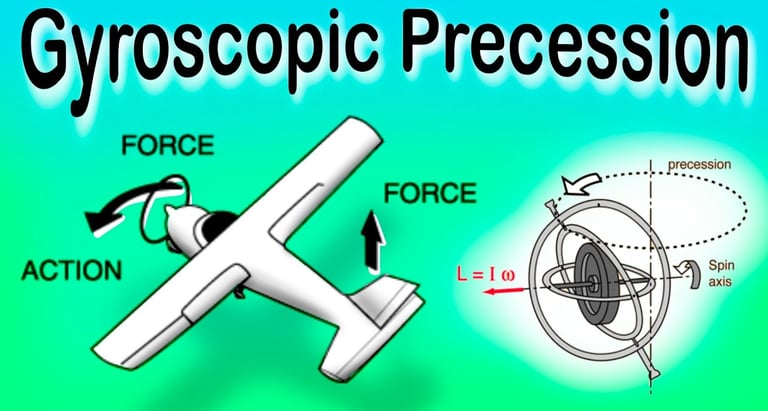
Several years later, our founder was taking courses for a private pilot's license. In a single-engine aircraft with a metal propeller, the gyroscopic precession is felt very strongly. This is such a phenomenon that the faster the propeller spins, the more strongly the aircraft pulls to the left. In flight, this isn't dangerous, though it is unpleasant. But on the ground, especially during takeoff — it's very dangerous. This is because you need to spin the propeller very quickly, which means the aircraft pulls off the runway to the left very forcefully. And leaving the runway, you meet a fence. You must stay on the runway. To compensate for precession, you simply need to apply force in the opposite direction, i.e., press the right pedal. If you press too lightly — precession wins and you fly off the runway to the left into the fence. If you push too hard — the pilot wins, and you still fly off the runway, just to the right fence. Therefore, the most frequent question heard in the cockpit was "How much should I press?" And the instructor's most frequent answer was, as you've already guessed: "Quantum Satis!"
The Skiing Experience
A few years later, our founder had to learn to ski in the mountains. Such a hard life. Skiing, as it turned out, is a completely counter-intuitive skill. At least, most ski instructors explain it like this:
"To slow down, shift your center of gravity forward. And to speed up — backward."
Intuition at speed pulls you back, but you need to go forward. And when there's no slope, you intuitively lean forward, but you need to go back. Or here's an example:
"To turn left, transfer weight to your right leg. And vice versa."
Well, it's already clear that intuition won't help here either. Though the same question arose sharply — How much weight should you transfer? And the answer was, of course: "Quantum Satis!"
Later our founder understood how it should have been explained to make the skiing skill seem intuitive. If you still don't know how and are interested in learning, drop us a couple of lines.
The Whiskey Connection

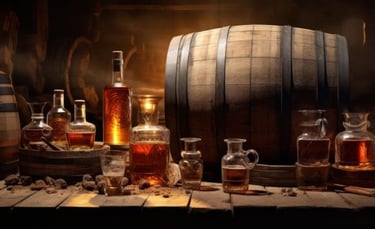
When our founder began exploring the world of whiskey, he discovered that no precise "recipe" exists. Or rather, it exists, but like the Coca-Cola recipe, every distillery keeps its recipe behind seven locks, in a fortress, in a casket, in an egg. And standing guard are Cerberuses, dragons, and various Lucifers. In short, the principle of production is clear, but in the details, the devil would break his leg. Through painstaking excavation of knowledge sources, as well as trial and error, it became clear what affects what and how. And it turned out that at practically every step from soaking the malt to bottling the "liquid sunshine," you need to know Quantum Satis of this or that action or component.
The Minimalist Philosophy
As a family — and Quantum Satis is a family activity — we embrace minimalism. But don't confuse minimalism with poverty or stinginess. True minimalism isn't about having less — it's about having and doing exactly what's needed and nothing more. No clutter. No excess. No shortage either.
The concept comes from the world of visual arts and design—those minimalist posters that make you stop and look, those elegant app interfaces where every element has purpose. The principle is simple: remove everything that distracts from what matters. Whether it's a poster, a website, or a product, minimalism lets quality speak for itself.
We apply this philosophy to whiskey-making. We don't add unnecessary ingredients to chase trends. We don’t distill more or less times just to comply with a certain tradition, we distill just enough to reach the mellow touch of the spirit. We don't age our spirits longer than they need, just to print a bigger number on the bottle. We don't dress our product like a pauper or a peacock — either extreme misses the mark.
In short, everything in our whiskey — from grain selection to bottle design — follows the principle of Quantum Satis: "As much as needed." Not more, not less. We constantly seek that golden mean where quality speaks for itself without crossing into pretension or kitsch.
The Logo


Look at our logo. At first glance — some scribbles. But if you concentrate, the shadow from invisible letters "QS" emerges. The letters aren't needed — they're brutal, too obvious. The shadow is precisely Quantum Satis to recognize the letters. The minimum possible and sufficient with maximum quality.
The Quantum Satis expression is a representation of modern minimalism. And the great Mark Twain confirms that:
"Too much of anything is bad, but too much good whiskey is barely enough."
Contact
Questions or thoughts? Reach out anytime.
info@quantumsatis.site
Phone: TBD
© 2026. All rights reserved.