How Alcohol Hijacks Your Brain
A Journey Through Your Nervous System - what do you earn and what’s the price. A desperate attempt to compact several scientific textbooks into one human-readable article
SCIENCE
4/4/202518 min read


Part 1: The Central Nervous System Under Siege
"Why is it that we rejoice at a birth and grieve at a funeral? It is because we are not the person involved." — Mark Twain
But when it comes to alcohol, dear reader, we ARE the person involved. And what happens inside your skull when you take that first sip — and the second, and the fifth — is a story worth telling.
Introduction: Your Brain as a City
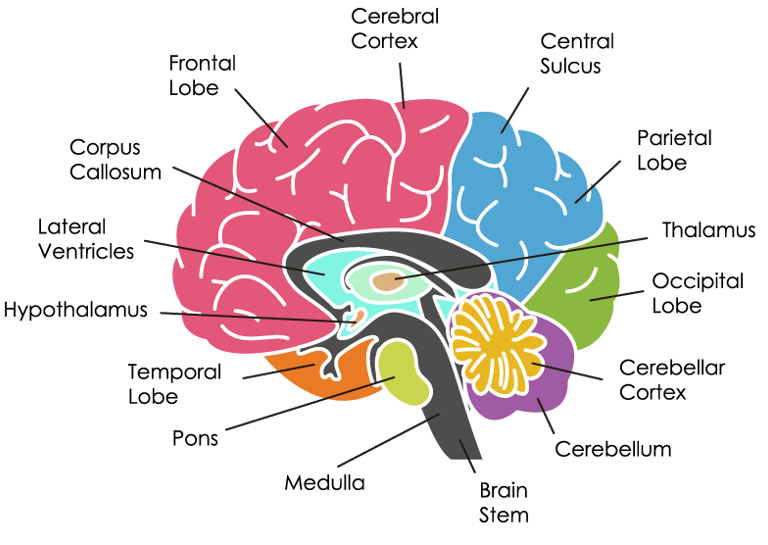
Imagine your brain as a bustling city with millions of inhabitants (we call them neurons — brain cells that send, receive and process the messages). Like any city, it has different districts:
The Executive District (prefrontal cortex) — where the mayor's office sits, making wise decisions, controlling impulses, and keeping you from saying what you really think about your boss
The Memory Archives (hippocampus) — the city library where every experience gets filed away
The Motor Department (cerebellum) — traffic control, managing every movement from walking to picking up a coffee cup
The Life Support Center (brainstem) — the city's power plant, keeping your heart beating and lungs breathing
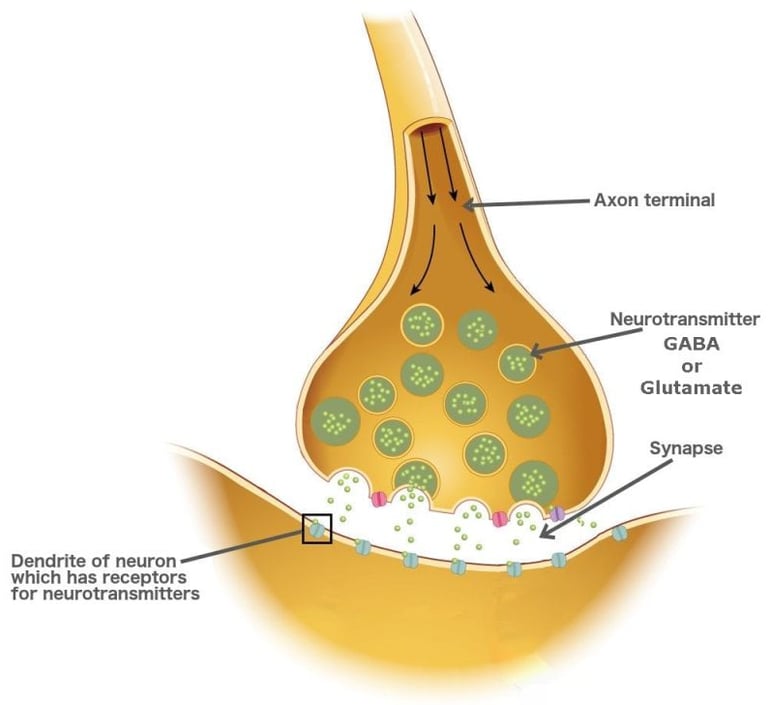
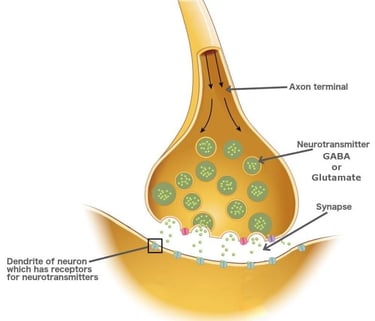
Now, in this city, neurons communicate by sending chemical messages across tiny gaps called synapses (from Greek "synaptein" meaning "to clasp together"). Think of synapses as telephone operators from the old days — messages arrive at the operator's desk, and she decides whether to connect the call or not.
When alcohol arrives in town, it's like a charming but mischievous troublemaker who starts tampering with these telephone operators. At first, it's subtle — just a few missed connections here and there. But as more alcohol floods in, entire communication networks begin failing, district by district, until the whole city starts shutting down.
Let's follow alcohol's journey through your brain city, from the first pleasant buzz to the dangerous blackout.
Act I: How Messages Travel (When Alcohol Isn't Around)
Before we meet our antagonist, let's understand the heroes of our story: the neurotransmitters (chemical messengers that neurons use to talk to each other).
Meet GABA (gamma-aminobutyric acid): Think of GABA as the city's brake pedal. It's an inhibitory neurotransmitter, meaning when it shows up at a synapse, it tells the receiving neuron: "Slow down. Relax. Don't fire." GABA keeps your brain from going into overdrive, prevents anxiety, helps you sleep, and stops you from acting on every random impulse.
Meet Glutamate: Glutamate is GABA's opposite — the accelerator pedal. It's an excitatory neurotransmitter that tells neurons: "Go! Fire! Send that signal!" Glutamate helps you think, learn, remember, and stay alert.
In a healthy brain, GABA and glutamate work in perfect balance — like a car with both gas and brakes working properly. Your Executive District uses this balance to make rational decisions: "Should I tell my mother-in-law her casserole tastes like cardboard?" Glutamate says "YES! Honesty!" in the “logical” part of the cortex. GABA says "NO! Consequences!" in the “cultural / politeness” part of the cortex. And usually, GABA wins. That's why you're still invited to family dinners.
The synapse in action:
A neuron gets excited and releases neurotransmitters (like GABA or glutamate) into the synapse.
These chemicals float across the gap (about 20 nanometers—1/50,000th the width of a human hair).
They dock onto receptors on the receiving neuron (like keys fitting into locks).
The receiving neuron either fires (glutamate) or doesn't fire (GABA).
The original neurotransmitters get recycled or broken down.
This happens billions of times per second throughout your brain. It's why you can read this sentence, understand it, remember it, and simultaneously breathe, maintain your posture, and not fall off your chair.
Now... enter alcohol.
Act II: Alcohol Crashes the Party
When you drink alcohol (chemically called ethanol—C₂H₅OH if you care, but let's just call it alcohol), it gets absorbed quickly through your stomach and small intestine into your bloodstream. Within minutes, it crosses the blood-brain barrier (the security gate that protects your brain from most chemicals) because alcohol is a small, sneaky molecule that the gate can't stop.
Once inside your brain, alcohol does something devious: it warps GABA and glutamate receptors in synapses.
Alcohol molecules change the form of GABA receptors in a way, which allows a single GABA molecule to do more work (calcium flow) than usual. When alcohol shows up, the GABA receptors say, "Oh, more brake pedal? Sure!" and they open up, making the neuron even MORE inhibited than normal.
The first effect: Enhanced inhibition
With alcohol boosting GABA's brake-pedal effect, neurons in your Executive District start slowing down. Those neurons that usually tell you "Don't say that," "Don't do that," "Think about consequences" — they start taking longer coffee breaks.
This is why, at low doses (Blood Alcohol Concentration around 0.02-0.05%, about one drink), people feel:
Less shy
More talkative
Braver (The prefrontal cortex's fear-and-caution neurons go offline first)
More confident
Research shows that the prefrontal cortex (your Executive District) is ESPECIALLY sensitive to alcohol — more than any other brain region. At concentrations that barely affect other brain areas, the prefrontal cortex is already stumbling. And this is the main reason why people want to drink alcohol.
But wait, there's more!
Alcohol doesn't just enhance GABA's brake pedal — it also cuts the accelerator cable. Specifically, it stretches NMDA receptors (N-Methyl-D-Aspartate receptors — a special type of glutamate receptor), making sodium ions harder to sneak into the neuron.
Imagine you're driving a car where someone is pressing the brakes harder AND disconnecting the gas pedal. That's what alcohol does to your neurons. The result: signals that should fire... don't. Messages that should get through... get blocked.
At first, this feels good. The constant anxious chatter in your head quiets down. You feel relaxed. Social situations feel easier.
Ideally, that’s the exact moment when you should stop an alcohol ingestion. It’s a good phase, peaceful mind. But remember - the “breaks” are already active and “gas” is somehow blocked. When you should “take an action” of “stop drinking”, you cannot.
Keep drinking, and the effects spread...
Act III: The Cascade of Consequences
As you consume more alcohol, your Blood Alcohol Concentration (BAC) rises, and the effects spread through your brain city like a power outage moving from district to district. Why “district to district” and not “all at once”?
First, it’s for safety reasons - very basic controls (of urination or breathing, for instance) are less sensitive. It allows you to survive the intoxication.
Second, it is designed to block you gradually. If you don’t grasp the initial stage of the harm, the effect becomes heavier, blocking more and more areas in the brain until… finally… full shutdown.
Stage 1: The Executive District Goes Dark (BAC 0.02-0.08%)
The mayor has left the office. Nobody's making executive decisions anymore. The city is running on autopilot.
What's happening: The prefrontal cortex — your judgment, impulse control, and "think before you act" center — is the FIRST to go offline.
Why it's first: The prefrontal cortex has the densest concentration of NMDA receptors that alcohol blocks. It's also responsible for complex, nuanced thinking that requires many neurons working together precisely. When alcohol starts slowing signals down, complex thinking fails first.
What you experience:
Euphoria (consequences seem distant and unimportant)
Reduced inhibitions (that text to your ex seems like a GREAT idea)
Impaired judgment (another drink? Why not!)
Increased sociability and confidence
Slower motoric reaction and lower precision: it’s harder to move your hands for doing a gentle job, it’s harder to even move the tongue.
At 0.08% BAC (the legal driving limit in most places), your executive functions are so impaired that you can't accurately judge your own impairment. This is the cruel irony: the part of your brain that says "I probably shouldn't drive and you’d better not to drink more" is the same part that's been shut down.
In Europe, the allowed BAC for driving is under 0.5 promille. This equals 0.05%. So most of us are permitted to drive a 2 ton metal cage without noticing what’s going on and with limited chances to respond to the situation in time.
Stage 2: The Memory Archives Start Failing (BAC 0.08-0.15%)
The city library's filing system has crashed. New books are coming in, but nobody's cataloging them. They pile up in the lobby and then... vanish. Tomorrow, you won't remember they ever arrived.
What's happening: The hippocampus — your memory formation center — starts struggling.
Why: The hippocampus relies heavily on glutamate signaling (the accelerator) to form new memories. When alcohol blocks glutamate receptors, new memories can't form properly. It's like trying to save a document when someone keeps unplugging your computer.
What you experience:
Memory gaps (fragments of the evening are missing).
Difficulty forming new memories.
Blackouts at higher levels — you're awake and functioning, but your brain isn't recording anything.
This is NOT the same as "passing out." During a blackout, you might be walking, talking, even having conversations — but your hippocampus isn't transferring any of it to long-term storage. The next morning, those hours simply don't exist in your memory.
This is the main reason why alcohol is not permitted for minors - they must learn and keep learning for a longer time. Also for adults in the third millenium, an ability to learn is the most crucial characteristic for a prosperous life.
Stage 3: Motor Control Fails (BAC 0.15-0.25%)
The traffic control center has stopped working. Cars (nerve signals) are crashing into each other, missing their exits, and causing chaos. Your hand tries to pick up a glass, and three different movement commands arrive at slightly wrong times—the glass tips over.
What's happening: The cerebellum — your coordination headquarters — loses function.
Why: The cerebellum coordinates hundreds of muscle movements simultaneously. Walking requires your cerebellum to manage balance, leg movements, arm swings, head position — all without you thinking about it. This requires PRECISE timing of neuronal signals. Alcohol's interference makes precise timing impossible.
What you experience:
Slurred speech (your tongue and mouth muscles aren't coordinating).
Stumbling, poor balance.
Slow reaction times.
Difficulty with fine motor skills (can't text, can't unlock doors).
Feel of flying or dizziness.
Stage 4: Basic Functions Start Shutting Down (BAC 0.25-0.40%)
The power plant is failing. Emergency systems that were supposed to be failsafe are now failing too. The city is going into complete blackout.
What's happening: The brainstem — your life support system — begins failing.
Why: The brainstem controls unconscious, automatic functions: breathing, heart rate, body temperature, gag reflex. These are supposed to be ALCOHOL-RESISTANT because they're essential for survival. They have fewer GABA receptors and different types of glutamate receptors. But at very high alcohol concentrations, even these fail.
What you experience:
Vomiting (the body's desperate attempt to expel poison).
Loss of bladder control, wet pants.
Hypothermia (temperature regulation fails).
Confusion and stupor.
Loss of consciousness.
Stage 5: Death (BAC 0.40%+)
The power plant has completely shut down. The city is dark, silent, and lifeless.
What's happening: Respiratory centers in the brainstem stop functioning.
Why: Even the most alcohol-resistant neurons eventually succumb to enough ethanol.
What happens:
Breathing slows dangerously or stops.
Heart rate becomes irregular.
Seizures possible.
Coma.
Death from respiratory arrest.
This is why you sometimes hear tragic stories of college students dying from "just" drinking games. They consumed so much, so fast, that their blood alcohol concentration rose to lethal levels before their body could process it.
Act IV: Meanwhile, Inside Brain Cells...
You might be wondering: "If alcohol is blocking all these signals, doesn't the brain try to break it down?"
Great question! Yes, but here's the problem: your brain is TERRIBLE at metabolizing alcohol.
Remember, the liver does 80-90% of alcohol breakdown. The brain handles only about 2-5% of the total alcohol you consume. But that local metabolism still matters for understanding what happens in your brain tissue.
The Brain's Alcohol Processing Team:
Your brain uses two main enzymes (proteins that break down chemicals) to handle alcohol:
1. Catalase (handles about 80% of brain alcohol metabolism)
Catalase lives in tiny organelles called peroxisomes (from "peroxide" because they handle hydrogen peroxide). Think of peroxisomes as your cell's hazardous materials disposal units — they break down toxic stuff.
Here's what happens:
Alcohol (ethanol) enters a brain cell.
Catalase in the peroxisomes says, "Ah, poison! Let me break that down."
Catalase converts ethanol into acetaldehyde (a more toxic chemical — we'll meet him properly in the next post).
Then another enzyme (ALDH) converts acetaldehyde into acetate (much less toxic).
Acetate eventually becomes CO₂ and water.
2. CYP2E1 (Cytochrome P450 2E1) (handles about 20% of brain alcohol metabolism)
CYP2E1 lives in the endoplasmic reticulum (ER) — think of the ER as your cell's manufacturing and packaging center, like an Amazon warehouse inside each cell.
CYP2E1 also converts ethanol to acetaldehyde, but with an unfortunate side effect: it generates free radicals (a carcinogens, highly reactive molecules that damage cells — more on this in the next post).
The Critical Problem:
Even working together, catalase and CYP2E1 in your brain can only process a tiny fraction of the alcohol flooding in. If you're drinking faster than your liver can process alcohol (which is easy to do), your brain is essentially drowning in ethanol while these two enzymes desperately bail water with teaspoons.
Meanwhile, that ethanol is blocking signals, shutting down districts, and causing chaos.
Different Brain Cells Handle It Differently:
Your brain has two main types of cells:
Neurons (the message senders): They mostly use CYP2E1 in their endoplasmic reticulum
Astrocytes (support cells that feed and protect neurons): They mostly use catalase in their peroxisomes
Both are trying to help, but both are overwhelmed if you drink (more than) enough.
Act V: The Long Game (When Your Brain Rewrites Its Own Rules)
Here's something important: alcohol's effects on your brain aren't just "turn it off, turn it back on."
Short-term changes:
While you're intoxicated, your neurons are actively being suppressed. The GABA receptors are over-activated, the NMDA receptors are blocked, and signals aren't firing properly.
Most of this reverses as alcohol leaves your system. Your liver processes about 15-20 mg/dL per hour (roughly one standard drink per hour). As your BAC drops, normal function gradually returns:
Executive District comes back online first (within hours)
Motor control returns (within hours)
Memory formation resumes (within hours to days if you had a blackout)
One drink, once in a while? Your brain barely notices.
If you drink occasionally and moderately — say, a glass of wine with Friday dinner, or a whiskey sipped slowly on special occasions — your brain treats this as a minor, temporary disruption. The city goes into "mild weather alert" mode, handles it smoothly, and returns to normal. Some research even suggests these occasional small doses might have modest benefits: reduced anxiety in social situations, slight mood elevation, enhanced social bonding.
The key word: occasional.
If you drink occasionally but heavily, your brain punishes you immediately, no mercy, for each single violation. That’s the nature of the hangover. Headache, oversensitivity to the light and sounds after “heavy party” is a reaction of the brain to exaggerated activity of GABA synapses. The cells are engaging destroy mechanisms (lysis) to kill or eliminate the “excessive” amount of braking sensors. From a sober point of view it's nonsense. It was just temporary over-activity of GABA receptors, they are in normal quantities, don’t kill them! But, no. The brain “hints” us to prevent such parties again. So, when many “braking sensors” are destroyed, even a minor irritation signal like speech at normal volume sounds like a thunder. Just because for several hours now the GABA receptors dominated.
BUT — and this is crucial — if you drink heavily and regularly, your brain doesn't just tolerate the disruption. It adapts. And that adaptation creates three devastating long-term consequences:
Long-Term Consequence #1: Tolerance (The Diminishing Returns Problem)
Your brain city realizes the troublemaker (alcohol) keeps showing up every day. So it installs more traffic lights (glutamate receptors) to compensate for the ones alcohol keeps blocking, and removes some brake systems (GABA receptors) since alcohol is adding extra brakes anyway.
Remember how alcohol enhances GABA (the brake) and blocks glutamate (the accelerator)? If your brain is constantly exposed to this, it says: "Okay, this is apparently our new normal. Let me adjust."
The brain's strategy:
Make MORE glutamate receptors (increase the gas pedal sensitivity to compensate for constant blocking)
Make FEWER GABA receptors (decrease the brake sensitivity to compensate for constant over-activation)
Change the TYPE of GABA receptors (specifically, upregulate α4-containing receptors and downregulate α1- and α3-containing receptors)
This is called neuroadaptation (your nervous system adapting to the drug), and it creates tolerance — you need progressively more alcohol to achieve the same effect.
What this looks like in real life:
Week 1: Two beers make you pleasantly relaxed
Month 3: Two beers barely do anything; you need four to feel relaxed
Year 1: Four beers is your baseline; you need six or eight to actually feel drunk
Year 3: You're drinking a bottle of wine or half a bottle of whiskey just to feel "normal"
Here's the cruel trap: while your brain adapted to alcohol's sedating effects (so you need more to feel drunk), it did NOT adapt to alcohol's toxic effects on your liver, pancreas, heart, and other organs. So you're drinking more and more to chase the same buzz, while simultaneously destroying your body faster and faster.
Your brain's reward system also changes. Initially, alcohol triggers dopamine release (the "feel good" chemical) in your brain's reward centers. But with chronic use, your baseline dopamine levels drop, and you need alcohol just to feel normal—not happy, just normal. Without it, you feel anxious, irritable, and depressed.
The bottom line: More consumption → need higher doses → never quite satisfied anymore.
Long-Term Consequence #2: The Happiness Paradox (From Joy to Depression)
At first, the troublemaker's visits made boring city council meetings more fun. But after years of daily disruption, the city's entire infrastructure has reorganized around managing the troublemaker. Now, when he's NOT there, everything feels wrong. The traffic lights don't work right, the brake systems are inadequate, the power plant runs too hot, and the whole city feels anxious and miserable. The only time it feels "normal" anymore is when the troublemaker shows up — but even then, it's not happy, just less miserable.
Here's a cruel irony that takes months to years to manifest:
Occasional, moderate drinking in social contexts can enhance mood, reduce stress, and contribute to happiness. That Friday night whiskey with friends? That celebratory champagne toast? These can genuinely improve quality of life for many people.
But chronic, heavy drinking does the exact opposite.
What happens in your brain:
Your brain maintains emotional balance through a complex interplay of neurotransmitters. When you drink alcohol regularly and heavily:
Serotonin dysregulation: Chronic alcohol disrupts serotonin (the mood stabilizer neurotransmitter) production and receptor function. Initially, alcohol might boost serotonin, but long-term use depletes it.
Dopamine depletion: Your reward system becomes dependent on alcohol for dopamine release. Natural pleasures (good food, sex, accomplishments, social connection) stop triggering dopamine properly. Nothing feels rewarding anymore except alcohol — and even alcohol stops working well due to tolerance.
GABA system exhaustion: Remember those GABA receptors that calm anxiety? Chronic alcohol makes your brain downregulate them. Now, without alcohol, your baseline anxiety is HIGHER than before you ever started drinking.
Glutamate system hyperactivity: All those extra glutamate receptors your brain made to compensate for alcohol's blocking? Now they're firing excessively when you're sober, creating agitation, restlessness, and an inability to relax.
Stress hormone dysregulation: Chronic drinking elevates cortisol (stress hormone) baseline levels. You're in a constant state of physiological stress.
What this looks like in real life:
Year 1 of occasional drinking: Alcohol makes social events more fun, helps you unwind after stressful weeks, contributes to good memories.
Year 2-3 of increasing drinking: Alcohol becomes necessary to feel relaxed; you feel irritable without it.
Year 4+ of heavy drinking: You feel depressed most of the time; alcohol temporarily lifts you from "miserable" to "numb" but never to "happy"; without alcohol you feel anxious, empty, hopeless.
Long-term chronic alcoholism: Clinical depression, anhedonia (inability to feel pleasure from anything), suicidal ideation.
Studies show that chronic alcoholics have significantly lower levels of GABA in their cerebrospinal fluid, and elevated levels of stress-related amino acids like aspartate and glycine. Their brains are chemically configured for misery.
The cruel irony: People often drink to escape sadness, but heavy drinking creates a neurochemical state of chronic sadness that's worse than whatever they were trying to escape. They're now drinking to temporarily relieve the depression that drinking itself caused.
The bottom line: Rare, small amounts → modest happiness; prolonged, heavy drinking → neurochemical misery.
Long-Term Consequence #3: The Withdrawal Trap (Why Quitting Becomes Torture)
After years of adjusting to the troublemaker's daily presence, the city has reorganized completely. When he suddenly stops showing up:
All those extra traffic lights (glutamate receptors) are active with nothing blocking them—traffic chaos!
The reduced brake systems (GABA receptors) can't slow things down—cars crashing everywhere!
The power plant (stress systems) runs dangerously hot without regulation.
In severe cases, the electrical grid (neurons) has uncontrolled power surges (seizures) that can damage infrastructure or even cause complete system failure (death).
Now comes the most sinister consequence: withdrawal syndrome and the nearly unbreakable cycle it creates.
Remember all those adaptations your brain made? More glutamate receptors, fewer GABA receptors? Those changes take weeks to months to develop, but they don't reverse quickly. They persist for days, weeks, sometimes months after you stop drinking.
What happens when you stop drinking after chronic heavy use:
Your brain is now configured like this:
Too many glutamate receptors (over-sensitive gas pedal).
Too few GABA receptors (weak brake system).
Downregulated serotonin system (mood instability).
Dysregulated dopamine (no pleasure from normal activities).
Suddenly, there's no alcohol to:
Block all those extra glutamate receptors.
Activate the remaining GABA receptors.
Provide artificial dopamine release.
The result is neurological chaos.
Withdrawal symptoms (timeline):
6-12 hours after last drink:
Anxiety and restlessness (glutamate overactivity).
Tremors, especially in hands (motor neurons firing excessively).
Sweating, rapid heartbeat (autonomic nervous system hyperactivity).
Nausea, headache.
Intense cravings (reward system screaming for dopamine).
12-24 hours:
All of the above intensify.
Hallucinations possible (visual, auditory, or tactile).
Insomnia (GABA deficiency — can't calm the brain enough to sleep).
Severe anxiety, panic attacks.
24-48 hours (DANGER ZONE):
Seizures become possible (uncontrolled glutamate-driven neuronal firing)
Delirium tremens (DTs) in severe cases:
Profound confusion, disorientation.
Severe hallucinations.
Autonomic instability (fever, dangerous blood pressure/heart rate changes).
Mortality risk 5-15% without treatment.
Weeks to months:
Post-Acute Withdrawal Syndrome (PAWS):
Depression, anxiety (neurotransmitter systems still rebalancing).
Sleep disturbances.
Difficulty concentrating.
Emotional instability.
Intense, episodic cravings.
Why the loop is so hard to break:
Immediate relief: Drinking alcohol immediately stops withdrawal symptoms. Within 30 minutes of that first drink, the tremors stop, anxiety eases, you feel "normal" again. This creates powerful negative reinforcement — alcohol becomes the solution to a problem alcohol itself created.
The kindling effect: Each withdrawal episode makes the next one worse. If you go through withdrawal, start drinking again, then try to quit again, the second withdrawal will be more severe. After multiple cycles, even moderate drinking can trigger severe withdrawal.
Length of recovery: Even after acute withdrawal ends (1-2 weeks), PAWS can persist for months. During this time, you feel depressed, anxious, and constantly think about drinking. Most relapses occur during PAWS, not during acute withdrawal.
Environmental triggers: Your brain has associated countless environmental cues with drinking (certain places, people, times of day, emotional states). These triggers cause automatic cravings through conditioned responses that persist long after physical dependence resolves.
Social pressure: If your social circle revolves around drinking, quitting means potentially losing your entire social network. Take this as a positive aspect. If your circles pushed you to the edge of life, perhaps it’s a good opportunity to steer onto a better path.
Medical necessity for supervised withdrawal:
This is why chronic alcoholics cannot safely "quit cold turkey." They need:
Medical supervision to monitor vital signs.
Benzodiazepines (drugs that activate GABA receptors, substituting for alcohol's effects temporarily).
Gradual taper of benzodiazepines over 5-14 days.
Nutritional support (thiamine, B vitamins—often deficient in alcoholics).
Possible anti-seizure medications.
Psychological support for the months-long recovery ahead.
The bottom line: Chronic heavy drinking creates a neurochemical dependency that makes quitting agonizing, dangerous, and often impossible without medical help. The brain's adaptations have created a trap that's extraordinarily difficult to escape.
The Three Trajectories: A Summary
Your relationship with alcohol can follow one of three paths:
Path 1: Occasional, Moderate Use
Frequency: Rarely (weekly or less).
Amount: Small (1-2 standard drinks).
Brain impact: Minimal neuroadaptation; temporary effects only; possible modest benefits.
Outcome: Can potentially continue indefinitely without significant harm to CNS.
Path 2: Regular, Moderate Use
Frequency: Several times per week.
Amount: 2-3 drinks per occasion.
Brain impact: Mild tolerance develops; some neuroadaptation; increased risk of sliding into Path 3.
Outcome: Unclear long-term trajectory; individual variation in vulnerability to dependence.
Path 3: Heavy, Chronic Use
Frequency: Daily or near-daily.
Amount: 4+ drinks per occasion, or drinking throughout the day.
Brain impact: Significant neuroadaptation → tolerance → dependence → withdrawal syndrome → depression → trapped in cycle.
Outcome: Neurological damage, psychological suffering, high risk of multiple organ system failure (covered in Part 2).
The transition from Path 1 to Path 3 can take years or mere months, depending on:
Genetic factors (some people are much more vulnerable to addiction).
Age of first use (earlier = higher risk).
Gender (female = higher risk).
Pattern of use (binge drinking accelerates progression).
Co-occurring mental health conditions.
Social and environmental factors.
Once you're on Path 3, returning to Path 1 is often impossible. The brain changes are too profound. For many people, the only viable option becomes complete abstinence—zero alcohol, ever again.
Conclusion: Why This Matters
Alcohol's effects on your Central Nervous System follow a predictable, escalating pattern:
0.02-0.08% BAC: Executive District offline → loss of inhibitions, poor judgment.
0.08-0.15% BAC: Memory Archives failing → blackouts possible.
0.15-0.25% BAC: Motor Control chaos → stumbling, slurred speech.
0.25-0.40% BAC: Life Support struggling → vomiting, unconsciousness.
0.40%+ BAC: Power Plant shutdown → respiratory failure, death.
The dose makes the poison, as the old saying goes. A small amount might make you pleasantly relaxed. A larger amount will impair your judgment and coordination. A very large amount can kill you.
Your brain tries to process alcohol locally using catalase (in peroxisomes) and CYP2E1 (in the endoplasmic reticulum), but these can only handle a tiny fraction — about 2-5% of what you consume. The rest has to wait for your liver to clear it at its slow, steady pace.
Understanding this cascade helps explain:
Why "liquid courage" works (Executive District shuts down first).
Why you can't remember what you did last night (Memory Archives failed).
Why drunk people stumble (Motor Control offline).
Why alcohol poisoning kills (Life Support shutdown).
Why alcoholics have seizures during withdrawal (brain adapted, then suddenly lost the drug it adapted to).
But this is only half the story. We've focused on your Central Nervous System — your brain and spinal cord. But alcohol doesn't stop there. It circulates through your ENTIRE body, affecting your liver, heart, pancreas, stomach, immune system, and more.
In the next article, we'll explore:
Why your liver bears the brunt of alcohol's damage (and what "cirrhosis" actually means).
What acetaldehyde (that toxic breakdown product we keep mentioning) does to your cells.
Why alcohol increases cancer risk.
How alcohol affects your heart, pancreas, and stomach.
Why chronic drinking weakens your immune system.
And much more.
Until then, dear reader, here's something to ponder: Every time you take a sip, you're conducting a biochemical experiment on the most complex structure in the known universe — your brain. The question is: are you running the experiment, or is the experiment running you?
Think positive, my friend:
If you ask yourself "Another drink?" and your honest response to yourself is "Why not?", that's the perfect answer to NOT have another dram. "Drink responsibly" does not mean "live miserably". It means "learn to understand yourself".
Contact
Questions or thoughts? Reach out anytime.
info@quantumsatis.site
Phone: TBD
© 2026. All rights reserved.